


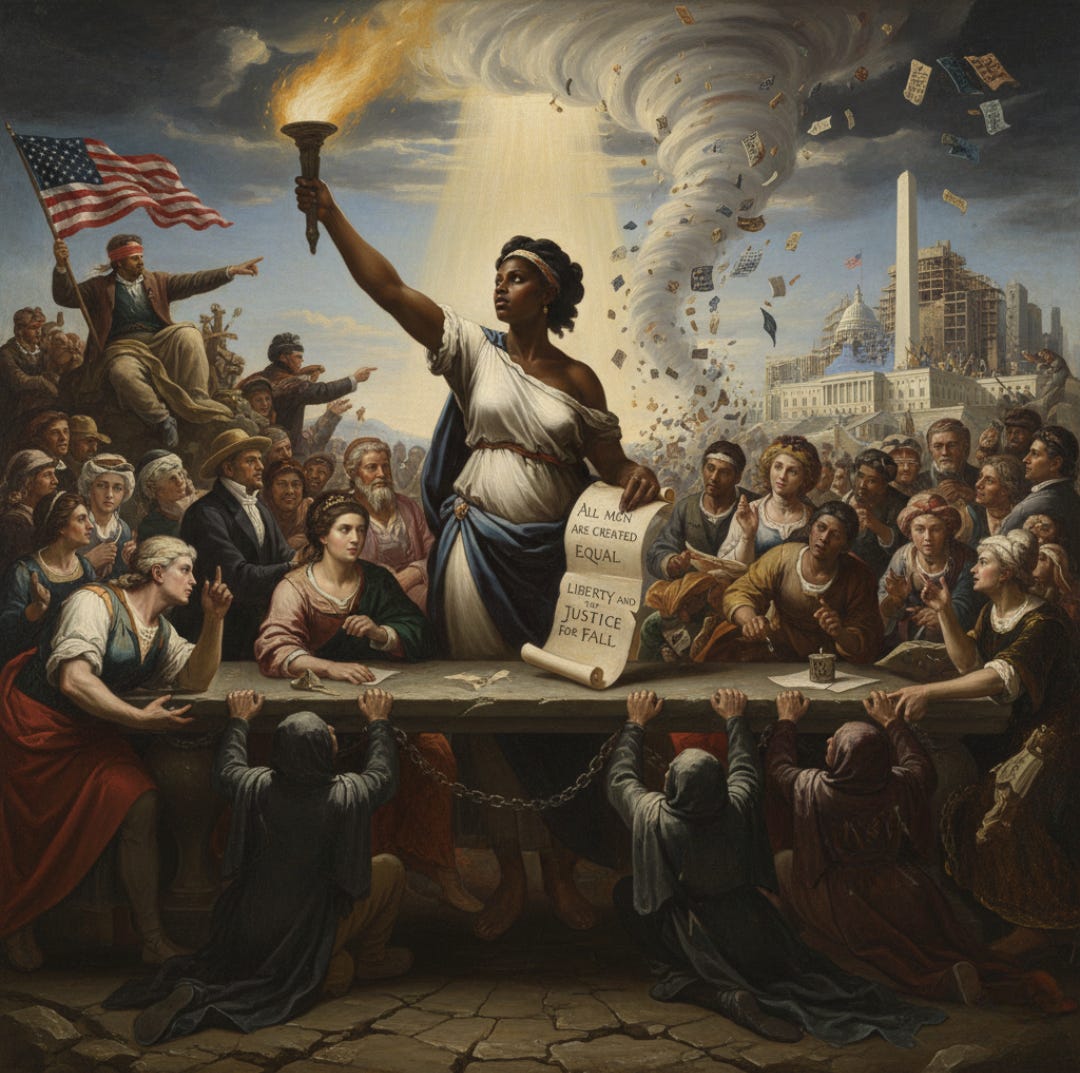
If there is anything genuinely exceptional about this country, it is not that our leaders are wiser than others, but that generation after generation of Americans—from every party and none—have resisted abuses of power in the name of a promise they refused to surrender.
The real test now is whether those who still care about that promise—on the right, the left, and in between—are willing to do more than wave a flag while other people’s freedoms shrink.
America is at a breaking point. The idea that this nation belongs to all people, not just a protected ruling class, is under open assault. The institutions that claim to defend “law and order” are increasingly staging a different kind of performance: a theater of fear designed to remind the marginalized, the dissenters, and even ordinary working people that their place is conditional, revocable, and policed.
The question is not whether this country has ever lived up fully to its ideals; it has not. The question is whether those ideals still bind our political imagination, or whether we will surrender them to a regime that uses the language of patriotism to justify domination.
The machinery of a constitutional republic matters, but it has never been enough by itself; what decides whether freedom grows or contracts is the moral will of those who have access to the democratic process, and whether they use that access to comfort power or to confront it.
Every major expansion of freedom in this country has come not from the system quietly fixing itself, but from people who refused to comply with injustice and forced power to recalculate its costs. From abolition to labor rights, from women’s suffrage to the civil rights and disability rights movements, the arc did not bend on its own; it bent because ordinary people organized, disrupted, and refused to go away.
The Constitution gives us tools for change—amendments, elections, courts—but those tools have only moved when confronted by organized resistance and moral pressure strong enough to make inaction more dangerous than reform. There is nothing inevitable or automatic about American progress; every ‘correction’ in our history was paid for by movements that forced those with power to choose between change and crisis.
It has always been this way, and the sooner we recognize it, the better chance we have at saving the American Dream of a more perfect union. Yes, it is still a dream until the American Revolution is complete in who counts as fully human and fully included. This position shatters our master narrative myths and reorients us toward a citizenship of liberation through what I call “critical patriotism.”
Critical patriotism does not seek to erase conservative convictions or any other set of cultural values; it insists that every person, including those who hold them, be fully included in the democratic process. Its demand is not ideological uniformity but a common commitment: that the basic rights and dignity of all people cannot be sacrificed to preserve the comfort of any one group.
In a truly democratic society, the rights of all will sometimes override the preferred cultural norms of particular communities; the price of non‑marginalization is accepting a place at a genuinely diverse table, not getting to own the table. Handled with care and purpose, this need not mean erasing distinct traditions or beliefs, but it does mean no group can claim a veto on the full humanity or participation of others.
Even under the best conditions, some will stubbornly refuse coexistence; they will demand a nation remade in their image or none at all. The American promise cannot bend to that ultimatum: a republic committed to liberty and equality cannot license extremism that requires other people to disappear in order to feel at home.
Living into that promise requires at least a minimum of civic maturity: a willingness to share public space with people whose beliefs unsettle us, and an openness to the possibility that the culture of power we grew up with is not the measure of justice.
Those who experience the decentering of their group as an attack on their existence will always be tempted to answer inclusion with backlash; the only antidote is the hard work of learning to see equality not as loss, but as the fulfillment of the very ideals they claim to defend.
Much of the cruelty in our politics flows from people who feel endangered not by tyranny, but by no longer being centered in every story; they mistake a more honest democracy for persecution. Critical patriotism does not indulge that confusion. It asks all of us—whatever our ideology—to look into the mirror of our real history, to see how often ‘being under attack’ has meant nothing more than being asked to share power.
Critical patriotism does not indulge that confusion. It asks all of us—whatever our ideology—to look into the mirror of our real history, to see how often ‘being under attack’ has meant nothing more than being asked to share power.
A patriotism that refuses this maturity, that will not accept a diverse table or the full inclusion of every neighbor, may be many things, but it is not worthy of the American Promise.
This is Part One of Regime Americana: Rescuing the American Promise from a Regime of Fear, a series tracing how the American Promise can survive an age of manufactured fear.
Avi Penhollow, welcomes thoughtful comments and questions from readers who are wrestling with these themes.