


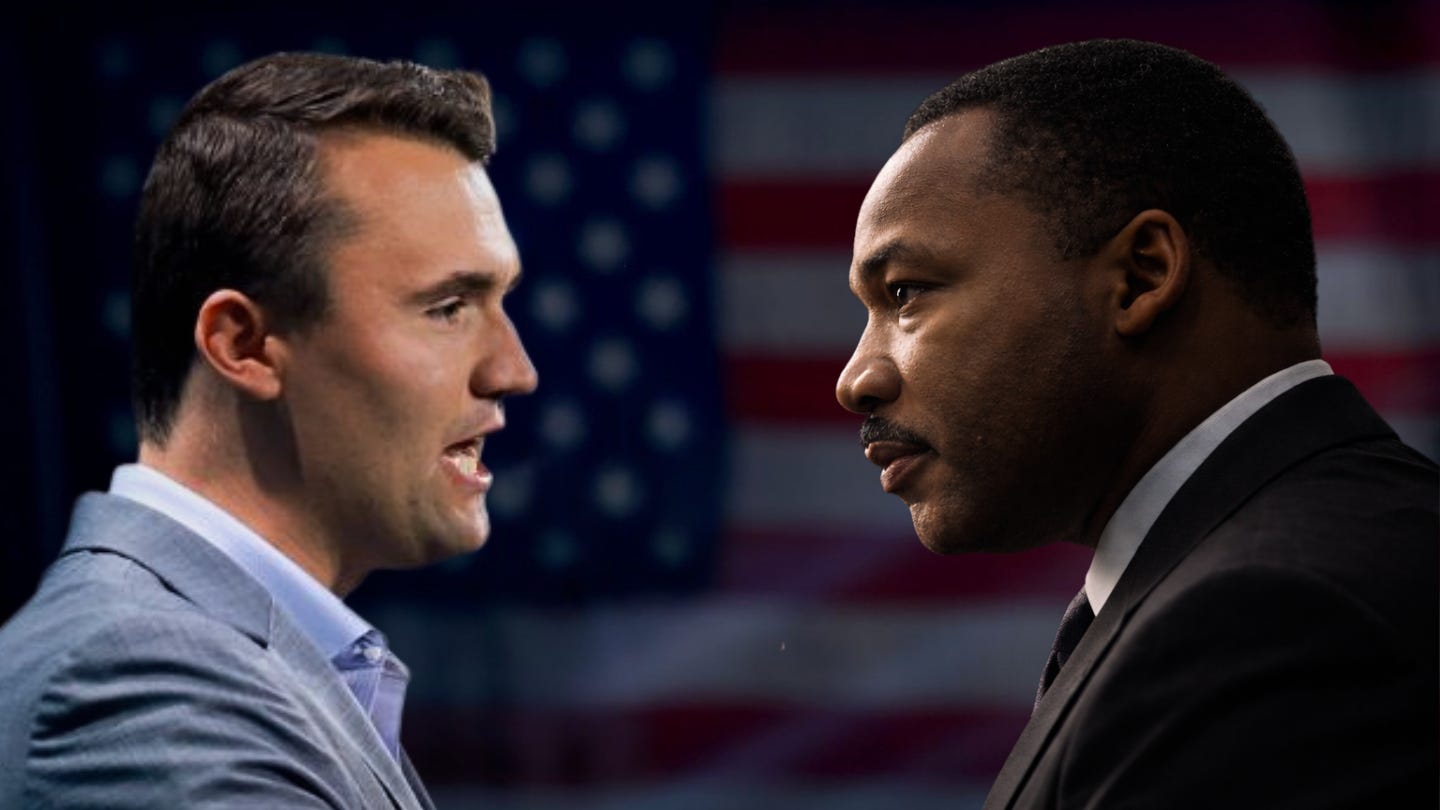
On the very day set aside to remember the man who forced America to look at itself without flinching, a movement now ascendant in power is asking us to forget him entirely. Or worse: to replace him. Not with another prophet of justice, but with a man who spent his career attacking the laws King died to secure—and whose followers now whisper, sometimes joke, sometimes shout, that it is his name that should be remembered instead.
This is not metaphor. It is strategy.
The assault on King’s legacy is not a stray provocation or an online stunt. It is a carefully constructed counter-tradition—one that treats white grievance as sacred truth and historical reckoning as heresy. And Charlie Kirk understood this perfectly.
Kirk’s war on MLK and civil rights
At AmericaFest in 2023, Kirk told a room packed with young conservatives that “MLK was awful,” that he was “not a good person,” and that the Civil Rights Act itself was “a huge mistake.” He framed this not as shock talk, but as sober historical correction. America, he insisted, had gone wrong the moment it tried to make racial equality enforceable.
This was not about King’s personal flaws. It was about King’s political clarity.
King named racism as a structure, not a feeling. He named poverty as violence, not personal failure. He named whiteness—not white people, but whiteness—as a lie that requires domination in order to survive. And for that, he had to be destroyed again.
Kirk even promised a coordinated MLK Day “hit job,” boasting that his staff was preparing content to “tell the truth” about King during the holiday that exists because King lived—and was killed—telling the truth about America.
From appropriation to erasure
For years, Turning Point USA tried to profit from King’s moral authority. They sold MLK merchandise. They quoted “Let freedom ring.” They wrapped themselves in a bowdlerized King who spoke only of character and never of power.
When that appropriation collapsed under scrutiny, the pivot was swift. Americans, Kirk claimed, had been fed a “fake history.” King’s “sanctified” image had to be dismantled. What followed was not nuance, but demolition.
Kirk called the Civil Rights Act an “anti-white weapon.” He blamed Black communities for gun violence. He described systemic racism as fiction. And yet, after his assassination in 2025, a familiar ritual began. His record was softened. His rhetoric laundered. He was recast as a fearless debater, a martyr to free speech, a “force of nature” taken too soon.
Movements that lack moral authority often counterfeit martyrdom.
The anti-MLK martyr
In the wake of Kirk’s death, some Christian nationalist circles attempted something obscene: to cast him as a rival saint. Rallies formed where supporters chanted “White men, fight back.” His name was invoked as a symbol of besieged white Christian manhood. Online spaces began floating the idea—sometimes as joke, sometimes as provocation—that MLK Day should be replaced with Charlie Kirk Day.
Black clergy and civil rights leaders rejected the comparison outright, calling Kirk what he was: an unapologetic racist whose words were dangerous. They insisted, correctly, that no one deserves to die for their beliefs. But they also refused the lie that his life stood in the same moral universe as King’s.
That distinction matters. It matters because the modern right demands endless grace for itself and absolute amnesia for its victims.
JD Vance and the doctrine of grievance
Into this carefully prepared ground stepped Vice President JD Vance.
At AmericaFest 2025—the first major Turning Point gathering after Kirk’s death—Vance announced that DEI had been relegated to the “dustbin of history” and assured the crowd, “In the United States, you no longer need to feel sorry for being white.” America, he claimed, now judges solely by character.
This is not reconciliation. It is absolution without confession.
There has never been an era in which white Americans were required to apologize for being white. What Vance offers instead is permission: permission to treat accountability as injury, memory as persecution, and equality as theft. It is the transformation of grievance into doctrine—the formal baptism of resentment as civic virtue.
Bernice King was right to name this lie. The language of “no more guilt” exists only to silence truth-telling. It is the vocabulary of people who believe justice is something done to them.
The moment of replacement
A nation reveals its conscience not by whom it praises, but by whom it needs to erase.
Martin Luther King Jr. Day has become intolerable to the modern American right not because King was imperfect, but because he was precise. He named racism as structure, poverty as violence, and peace as incompatible with domination. That clarity is dangerous. And so it must be buried—replaced by grievance dressed as courage, resentment crowned as faith, and a man like Charlie Kirk offered as substitute.
For years, Republicans tried to neutralize King by quoting a single line while gutting voting rights, dismantling affirmative action, and criminalizing poverty. MLK Day became a safe ritual, emptied of threat.
That pretense is over.
Kirk called King “awful.” He called the Civil Rights Act a mistake. His successors no longer bother pretending this is about honoring King’s words. It is about erasing the tradition he belonged to—and installing a new civic religion in its place.
King spent his final years condemning racism, militarism, and poverty as interlocking evils. Charlie Kirk spent his career trying to roll back the legal victories King died for. And now his heirs—from Turning Point USA to JD Vance—are attempting to turn that backlash into the governing faith of American life.
This is the choice before us in 2026.
We can remember Dr. King as he was: a threat to unjust power, an indictment of American innocence, a man who refused to confuse comfort with peace.
Or we can remember Charlie.
The country will decide which memory it can live with—and which one it must destroy in order to survive.