


George Washington is endlessly conscripted as a mascot for whatever version of America modern politicians want to sell. The viral quote in that meme—“It is impossible to rightly govern the world without God and the Bible”—is a perfect example. It is not history; it is marketing.
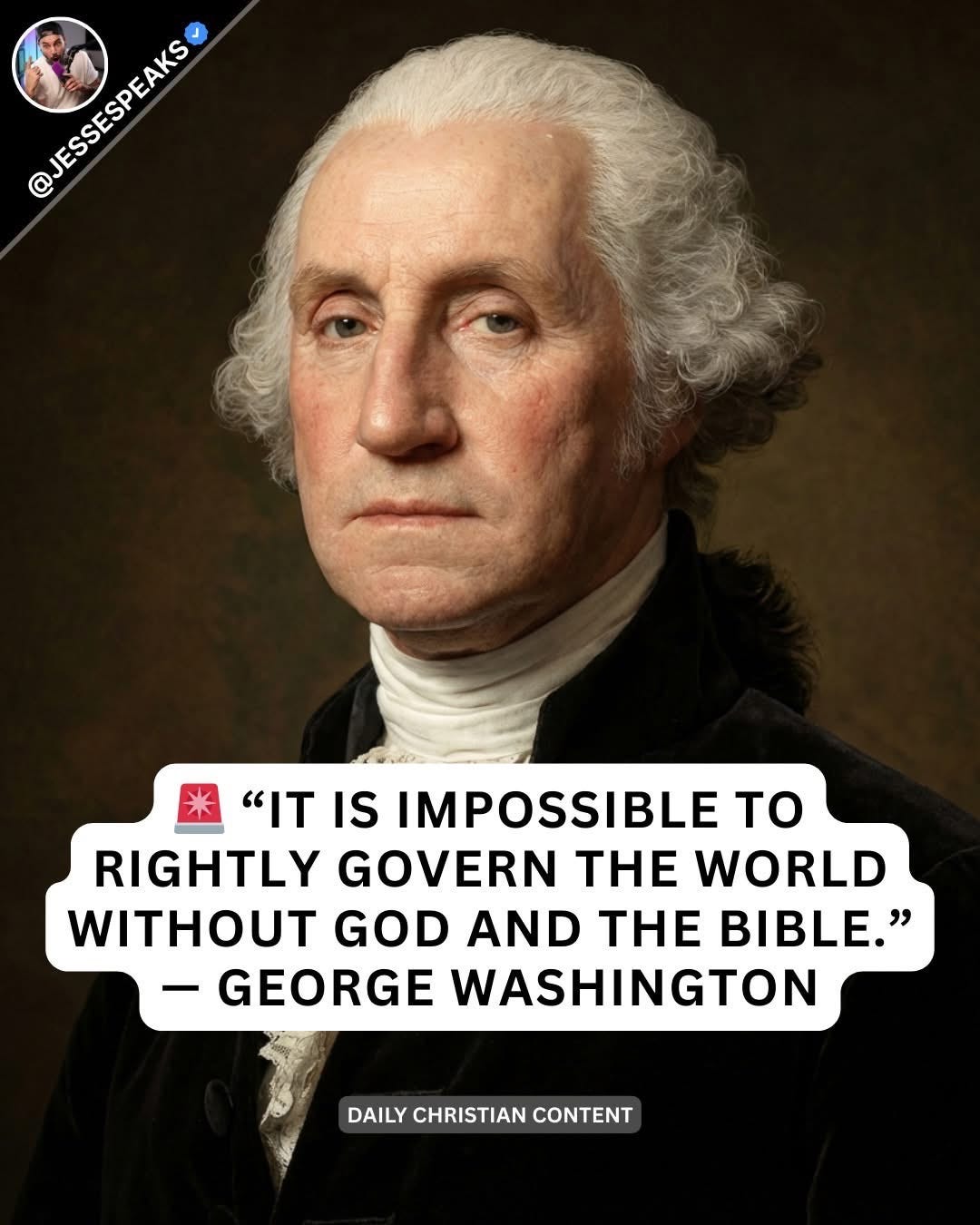
There is no credible record of Washington ever writing or saying that sentence. It does not appear in his letters, speeches, diaries, or official papers. The editors of The Papers of George Washington do not include it. Mount Vernon’s research staff classify it as misattributed. The line surfaces in print in the 20th century, long after Washington’s death, attached to him without documentary support. It reads less like an 18th-century Virginia statesman and more like a modern culture-war slogan retrofitted onto a powdered wig.
The real Washington did invoke religion—but in the language of “Providence,” “the Author of the Universe,” and “the Great Ruler of Events.” His public religiosity was deliberately broad and non-sectarian. He attended church. He supported chaplains. But he rarely mentioned Jesus explicitly in his public writings, avoided doctrinal specificity, and resisted clergy who tried to extract overtly Christian confessions from him. That wasn’t cowardice; it was governance. He was presiding over a fragile republic of Anglicans, Presbyterians, Quakers, Catholics, Deists, skeptics, and enslaved Africans whose religious worlds were far more complex than any meme can capture.
He understood that the new nation could not survive if tethered to a single sect.
This is where the myth becomes dangerous. If you accept that the United States can only be “rightly governed” when it submits to “God and the Bible,” then constitutional neutrality starts to look like betrayal. Religious pluralism looks like rebellion. Secular law becomes treason against an imagined founding covenant. A fabricated sentence smuggles an entire theocratic political theology into one tidy sound bite.
But there is an even harder truth that meme culture never wants to touch: Washington was a slaveholder.
He owned, bought, and sold human beings. At Mount Vernon, hundreds of enslaved men, women, and children labored under his control. He signed advertisements for runaways. He pursued Ona Judge for years after she escaped rather than be transferred as property. His eventual decision to free the enslaved people he personally owned—upon his wife’s death, not during his lifetime—did not dismantle the system that enriched him.
You cannot harmonize the plantation ledger with the image of a revival-tent statesman whose politics flowed cleanly from the Sermon on the Mount. The founding generation was capable of articulating breathtaking principles about liberty while simultaneously denying liberty to entire populations. That contradiction is not a footnote. It is the central tension of the American story.
To say this is not to cancel Washington. It is to refuse to canonize him.
He helped establish a republic that rejected divine right monarchy and enshrined government by consent. He voluntarily relinquished power—an act almost unthinkable in the 18th century. He supported religious liberty in practice, including protections for minority faiths. Those are achievements worth honoring.
But honoring is not idolizing.
Critical patriotism distinguishes between the American Promise and the flawed men who first articulated it. The promise is that rights are inherent and government exists to secure them—not to enforce one faction’s theology. The founders only partially realized that promise. Later generations—abolitionists, suffragists, civil-rights organizers—forced the nation closer to its own stated ideals.
The meme version of Washington collapses that tension. It offers a cardboard saint whose authority is meant to end debate. If Washington said it, the argument is over.
But once you recognize the quote is fabricated and the man was morally complex—visionary in some respects, compromised in others—the spell breaks. And better questions emerge:
What moral framework actually protects freedom in a pluralistic republic?
How do we restrain power—including religious majorities?
How do we extend the language of liberty to those it once excluded?
The United States does not need a pseudo-biblical origin myth to justify its existence. It needs honesty. The founding was visionary and violently incomplete. The founders were architects and obstacles. Patriotism is not preserving their mythology in amber; it is extending the principles they only partially grasped.
A mature republic does not require invented quotations to survive. It requires citizens strong enough to face the truth—and courageous enough to build something more just than what they inherited.